We paused a PMax campaign running on zero setup, built the infrastructure, then rewrote the site from scratch
Rent a Car · Azerbaijan · 50 vehicle fleet
- Sector
- Car rental
- Market
- Baku · GYD airport
- Work
- Measurement setup + Google Ads + web development
- Website
- omex.az
Who, where, selling to whom
A mid sized car rental operator based in Baku, running a fleet of 50 vehicles. The target audience was tourists in Azerbaijan: visitors who had just arrived and were looking for a car, plus travellers whose need for a rental came up mid trip.
The difficulty is that this audience sits geographically on top of local users. Location targeting alone does not separate a tourist from a resident: both search in the same city at the same moment. The split can only be built on language, search behaviour and intent signals.
What the client saw
When they came to us a Performance Max campaign had been live for three weeks and the budget was being spent. The traffic coming in did not match the intended tourist audience: spend was flowing with no matching rental demand.
The ads were running, but who they were shown to was anyone’s guess.
What we found
There was no measurement setup on the site at all. No GTM, no GA4, no conversion tag, no dataLayer. The campaign had been created, but targeting, signal and the conversion definition were left empty.
- PMax campaignrunning, budget spending
- GTM containernone
- GA4 propertynone
- dataLayernone
- Ads conversion tagnone
- Historic period analysisnot possible
For Performance Max specifically this is the most expensive kind of mistake. PMax is not a targeting tool, it is an optimisation engine: it decides what to do from the conversion signal it receives, not from what you intended. If you do not tell the campaign which action is valuable, the algorithm defines “value” itself and in practice buys the cheapest impressions. The result: budget flows, clicks arrive, rentals do not.
In a business targeting tourists this compounds. Because the audience sits geographically on top of local users, the targeting filter has to be the conversion signal, not the location. With no signal, PMax picks the cheapest inventory, which in practice means broad, low intent traffic inside the country. The campaign was optimising for the exact opposite of the audience it needed to isolate.
In short: the only thing separating a tourist from a local user was the data itself, and that data was never being collected.
Three weeks of spend also left no usable data behind. Because conversions were not measured, that period cannot be analysed after the fact.
What we did
- 1We stopped the spendThe first move was to pause the campaign. Every further day without measurement in place meant budget that could not be recovered.
- 2We built the infrastructureGTM container setup, GA4 property configuration, dataLayer design and implementation, defining the critical steps of the rental flow as events, and connecting and validating the Google Ads conversion tags.
- 3We did not put the ads back liveThe campaign stayed off until the whole setup had been tested and verified. This was the decision we discussed most with the client. Everything a campaign learns from wrong data is a wrong lesson that has to be unlearned later.
- 4Relaunch with the right structureA campaign type matching the audience’s intent stage was chosen. Signals separating the tourist segment from local traffic were built into the campaign structure.
What changed
- ImpressionsOld campaign: 7,450New setup: 120,000
- ClicksOld campaign: 407New setup: 14,900
- ConversionsOld campaign: 11New setup: 1,110
- SpendOld campaign: $156New setup: $11,200
- CTROld campaign: 5.46%New setup: 12.42%
- Conversion rateOld campaign: 2.70%New setup: 7.45%
- Cost per clickOld campaign: $0.38New setup: $0.75
- Cost per conversionOld campaign: $14.18New setup: $10.09
Note what happened: clicks got MORE expensive. Cost per click doubled, from $0.38 to $0.75. If we had been chasing cheap clicks, that number would read as a failure.
But because the traffic coming in was the right audience, the conversion rate almost tripled: from 2.70% to 7.45%. The result is that cost per conversion fell by 29%. The client pays more for a click and less for a customer.
Spend itself also went up, and that was a deliberate decision. The client initially expected a high return from a very small budget; once measurement was fixed, it became visible which campaign actually produced bookings, and budget was moved there. Without measurement in place, that increase would have been blind.
The detailed data from the first period cannot be recovered. Because conversion tracking was not set up correctly on the old campaign, that period can only be compared on totals. This is the hidden cost of a campaign without a setup: the money goes, and no learning stays behind.
Web development
After the first project the client came back to us to have the site rewritten, because of the problems they were having with their existing software vendor.
- Even the simplest content change request took two weeks
- When the site went down, no urgent help was available
- Page slowness had been reported two months earlier with no improvement made
- The interface was visually dated and failed to build trust at the payment step
In car rental, that last item hits revenue directly. A user has to trust the site before entering card details or creating a booking. An interface that does not inspire trust cuts conversion no matter how good the advertising is.
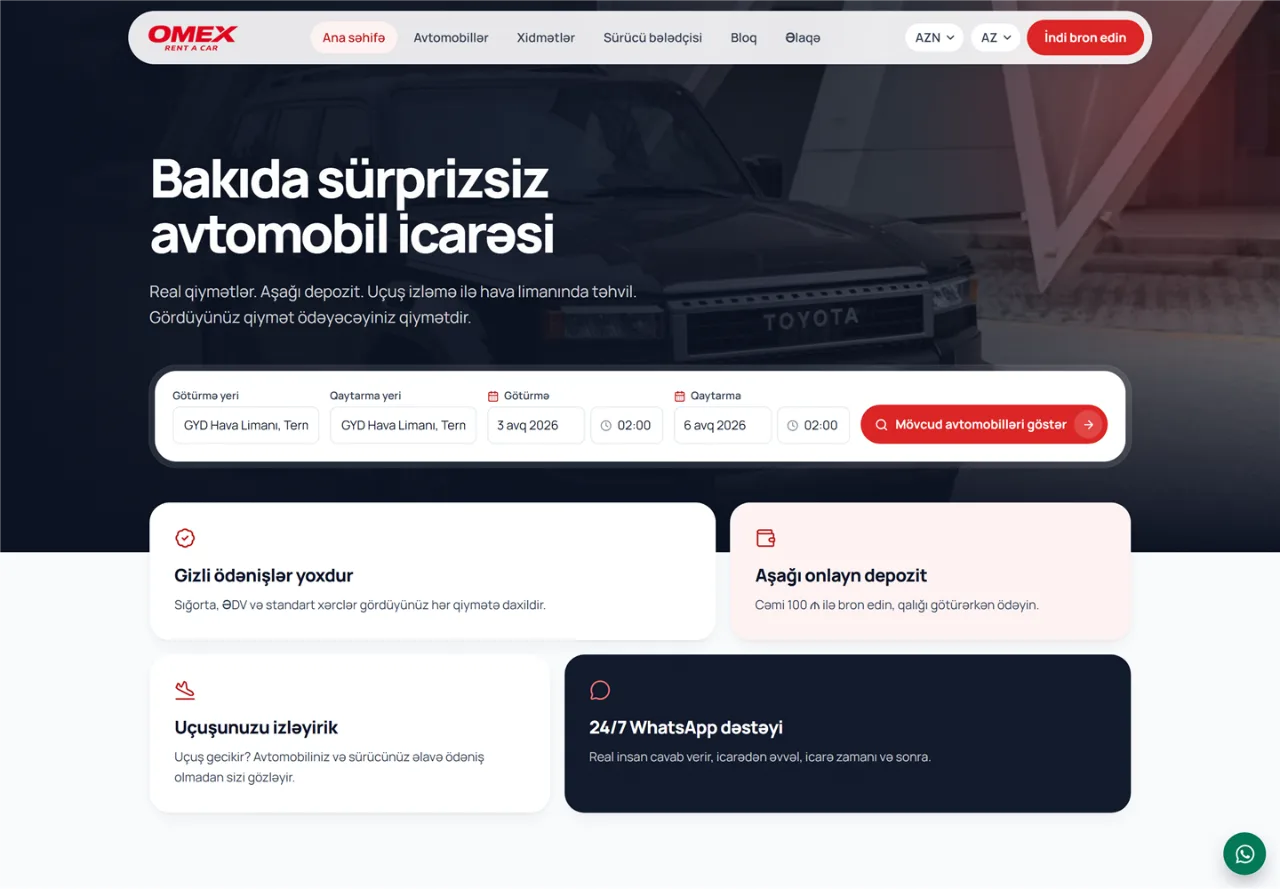
We rewrote the site from scratch and delivered it within two weeks. The new version kept every function of the previous admin panel and added new management features on top. Page speed and interface trust were treated as primary design criteria.
- Performance scoreOld site: 49 / 100New site: 79 / 100
- LCP · largest contentful paintOld site: 5.0 sNew site: 2.4 s
- INP · interaction to next paintOld site: 520 msNew site: 240 ms
- CLS · cumulative layout shiftOld site: 1.2New site: 0.067
Two of the three metrics moved from "poor" to "good". CLS matters most here: 1.2 means buttons move while the page loads and the user taps the wrong thing. In a booking flow that is a lost reservation.
What this work does not prove
Showing improvement on an account with zero setup proves the effect of a correct setup. But we do not promise a jump of the same size on an account that is already set up correctly. For an account with a healthy setup and a problem elsewhere, the expectation should be different.
Rewritten from scratch in two weeks
Page speed and interface trust were treated as primary design criteria. The booking flow completes on a single page, and the deposit and terms are visible before the payment step.
Services used in this project
Let us review your setup within 48 hours.
No account access needed. Your website address and a short note are enough, we check the rest.
- 01AuditYour current setup is checked against 12 points.
- 02Audit reportThe result of the 12 point review: what works, what does not, and in which order to fix it.
- 03CallA 30 minute call, questions and answers. No commitment.
- 04DecisionIf you want to work together we draw up a plan. If not, the audit report stays yours.
- 12 point review
- Within 48 hours
- No commitment